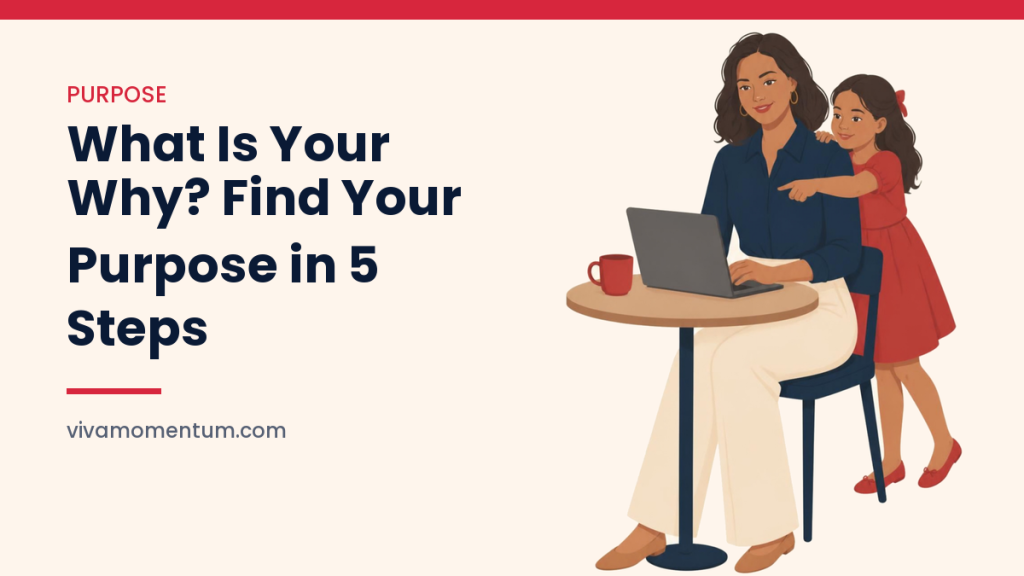
The short answer: your “why” is the reason behind what you do, the thing that keeps you going when a goal gets hard. You find it in five steps: notice what genuinely motivates you, look for patterns in your past, ask yourself a few honest questions, write the answer down in one or two sentences, and then test it with small experiments in real life. It is rarely a single “aha” moment. It usually gets clearer as you act on it.
If you have ever started a goal full of energy and dropped it three weeks later, you already know why this matters. Plans built only on “I should” tend to fade. Plans connected to something you actually care about last longer. This guide walks through the five steps with questions you can answer today, in a notebook or a notes app, in about half an hour.
What is your “why”, and why does it matter?
Your why is the purpose underneath your goals: not what you do, but what you are doing it for. The phrase was made popular by Simon Sinek, whose book Start With Why (2009) and TED talk argue that people and organisations who are clear on their why find it easier to keep going and to bring others along.
A why helps in three practical ways:
- It makes decisions easier. When an opportunity comes up, you can ask whether it moves you towards what you care about.
- It keeps you going on hard days. If fitness matters to you because you want the energy to play with your kids, that reason is far more useful at 6 a.m. than “I should exercise”.
- It turns work into something you chose. A business owner who cares about sustainable practices will find ideas a competitor never looks for, because the why points their attention.
Step 1: What actually motivates you?
Start with what already gives you energy, not with what you think your purpose should be. Think back over the last few months and write down the activities that made you feel alive, the ones you look forward to and the ones where time disappeared.
Then ask “why?” about each one, more than once. Say you love helping a friend fix her website. Why? Because you like solving problems. Why does that feel good? Because you like seeing someone go from stuck to confident. That last answer is much closer to a why than “websites” ever was.
Write the answers down. Your why is usually hiding in the second or third “why”, not the first.
Step 2: What patterns show up in your past?
Look back at your past wins and hard times, because the same themes tend to repeat. Make a quick list of 10 moments you are proud of, from any part of life: school, work, family, hobbies, volunteering. Next to each one, write what you were doing and what made it feel good.
Now read the list as if it belonged to someone else. You might notice that you keep ending up as the organiser, or the teacher, or the one who makes things look beautiful, or the one who stands up for people. Those repeats are clues.
It helps to ask two or three people who know you well: “When have you seen me at my happiest?” They often notice what you have stopped seeing in yourself.
Step 3: Which questions help you find your purpose?
A few honest questions do more than hours of thinking in circles. Answer these quickly, without editing yourself:
About what you enjoy
- What activities make me lose track of time?
- What do I enjoy doing even when it feels challenging?
- If money were no object, how would I spend my time?
About fulfilment
- What activities or hobbies bring me genuine happiness?
- When do I feel most fulfilled in my personal or professional life?
- Which accomplishments have brought me a deep sense of satisfaction?
About impact
- How do I want to contribute to my community?
- Which issues or causes do I care about?
- What change would I like to see in the world, even a small one?
Circle any words that show up in more than one answer. Words like “teach”, “create”, “freedom”, “family” or “fairness” are the raw material for the next step.
Step 4: How do I write my why down?
Write it as one or two plain sentences you could say out loud. A simple format, from Simon Sinek’s follow-up book Find Your Why, is: “To [what you give] so that [the difference it makes].”
Some examples:
- “To help busy parents cook real meals so that families get to eat together more often.”
- “To teach beginners one skill at a time so that they feel capable instead of overwhelmed.”
- “To build a business from home so that I can be there for my kids and still do work I’m proud of.”
If you want a longer version, turn it into a personal mission statement by adding:
- Your core values: the three or four principles you want to live by.
- Your long-term goals: where you want to be in a few years.
- Your passions: the activities from Step 1 that you want more of.
- Your impact: who you want to help and how.
Keep it somewhere you will see it: on your desk, as your phone’s lock screen, at the top of your planner. Then use it:
- For decisions: before you say yes to something, check it against your why.
- For priorities: put the tasks that serve your why at the top of the day.
- For focus: when a shiny new idea shows up, ask if it fits.
- For hard days: reread it when you feel like giving up.
Expect to rewrite it. A why you wrote at 25 can look different at 40, and that is normal.
Step 5: How do I test my why in real life?
Test it with small, low-risk experiments instead of one big leap. A why on paper is a guess. Doing something small with it tells you whether it is true.
Pick one thing you could try in the next two weeks. If your why is about teaching, explain something you know to a friend, or write one short how-to post. If it is about creating, make one small thing and share it. If public speaking scares you but your why needs it, start with a few close friends before a room of strangers.
After each experiment, write down three things: how it felt, what surprised you, and whether you would do it again. A failed experiment is useful too. It tells you what to cross off, and every one you run makes the next one easier.
Challenges are part of this. Think of a styrofoam cup next to a ceramic one: the styrofoam is light and easy, but the ceramic is the one that survives heat and pressure. Each hard thing you get through because of your why makes you a little sturdier.
Putting your why to work
Knowing your why is the start; using it every day is what changes things. Go back to your sentence from Step 4 and choose one small action this week that matches it. Then, once a month, look at your calendar and ask how much of your time actually went to it.
If you need words to get started, these “what is your why” quotes, each one correctly credited are a good warm-up. If you are not sure what direction your life should take at all, start with what to do when you don’t know what to do with your life. And when your why turns into a goal, this guide on staying motivated helps you keep going.
Questions people ask
What if I’m still unsure about my why?
That is normal. Keep running small experiments from Step 5 and keep notes. Clarity usually comes from doing things, not from thinking harder.
Can my why change over time?
Yes. As your life changes, your priorities shift, and your why can shift with them. Revisit your sentence once or twice a year.
Can I have more than one why?
Yes. Many people have a why for work and another for family or health. They often share the same root, such as freedom or helping others.
What if my current job doesn’t match my why?
Start small inside the life you have. Volunteer for a cause you care about, take on one project at work that fits, or spend an hour a week on a side project. Small steps still count.
How do I know I’ve found my real why?
It feels true when you read it, it gives you energy rather than guilt, and it still makes sense on a bad day. If it only sounds good, keep testing.
If your why involves building something of your own online, the free VivaMomentum Starter Kit is a simple first step.
Get the free VivaMomentum Starter Kit
Keep reading
Discover more from VivaMomentum
Subscribe to get the latest posts sent to your email.