The short answer: six AI niches a beginner can start without coding are AI content creation, faceless YouTube channels, AI automation services, AI-assisted design, AI market research, and AI workflow consulting. Each one sells something businesses already pay for; AI only makes the work faster. Pick the one that matches a skill you already have, learn two or three tools properly, and make one sample this week.
Is it too late to make money with AI? No. Businesses of every size are still working out how to use these tools, and most of them would rather pay someone who already knows than spend months learning. That gap is where a beginner fits.
You don’t need to code for any of the six niches below. You need one skill you are willing to practise, two or three tools you learn properly, and a way to show people what you can do. This guide explains what each niche involves, who pays for it, how the money arrives, and the one thing to do this week if it suits you.
You will not find income figures here. Earnings in all six depend on your skill, your hours and the clients you find, and any number we printed would be a guess dressed up as a promise.
How do I judge an AI niche before I pick one?
Check whether people already pay for it, whether you can show a sample quickly, whether it repeats, and whether the skill outlasts the tool. Ask those four questions of any idea, including the ones below:
- Does someone already pay for this without AI? If businesses buy blog posts, videos or research today, AI only changes how fast you deliver it. Brand-new markets are much harder to sell into.
- Can you show a sample in a week? A beginner wins work with examples, not credentials.
- Does it repeat? Monthly work (a newsletter, an automation you maintain) builds income faster than one-off jobs.
- Will the skill still matter if the tool changes? Writing, research and process thinking outlast any single app.
1. AI Content Creation
Businesses need a steady flow of blog posts, newsletters, product descriptions and social captions. AI can speed up research and first drafts, but the work clients pay for is the human part: checking facts, matching their voice and cutting the filler AI tends to add. Google says it judges content on quality and usefulness, not on how it was produced (Google’s guidance on AI-generated content), so careful editing is the skill, not the shortcut.
Who pays for it
Small businesses without a marketing team, agencies that need extra hands, and online shops with hundreds of product pages to write.
How you get paid
Per article or per batch at first, then a monthly package once a client trusts you (for example, four posts and a newsletter each month).
Tools to learn first
- ChatGPT or Claude for drafting (which one to try first)
- Grammarly or a similar checker for clean copy
- Perplexity for finding sources you can cite
Your first step this week
Write three sample pieces in one industry you know, edited until you would put your name on them. Those three samples are your portfolio. If you want them to be found in search, start from AI-assisted keyword research so each sample answers a question people actually ask.
2. Faceless YouTube Channels
A faceless channel publishes videos without the creator on camera: narrated explainers, screen recordings, animated lists. AI helps with scripts, voiceover, editing and captions. The hard part is the same as on any channel: choosing a topic people search for and publishing on a schedule for months.
Who pays for it
Viewers do not pay directly. Money comes from YouTube ads once you qualify, from sponsors, and from your own products or affiliate links.
How you get paid
YouTube ad revenue needs the Partner Program, which currently asks for 1,000 subscribers plus either 4,000 watch hours in the last 12 months or 10 million Shorts views in the last 90 days (YouTube’s eligibility page). Until then, affiliate links and a simple digital product are the realistic routes.
Tools to learn first
- ChatGPT or Claude for scripts and outlines
- ElevenLabs for voiceover
- Canva for thumbnails
- CapCut or Descript for editing
Your first step this week
Pick a narrow topic, write five video titles people would search for, and make the first one. Publishing beats planning.
3. AI Automation Services
Most small businesses still copy data between apps by hand: form entries into a spreadsheet, new leads into an email list, bookings into a calendar. With no-code tools you can connect those apps so the work happens on its own, and add an AI step that sorts, summarises or drafts replies.
Who pays for it
Service businesses (clinics, salons, agencies, coaches) and online shops with repetitive admin.
How you get paid
A fixed fee to build each workflow, then often a monthly fee to look after it when apps change. That monthly part is why this niche can grow into steady recurring work.
Why the upkeep matters, from my own sites. I run my publishing business on automations: scripts that fill social media queues, check links and draft newsletters. In September 2026 I found the same failure four times. A social channel kept posting for days, then went silent. The script feeding it had stopped, the queue simply ran dry, and nothing reported an error, because nothing was running that could fail. The fix was not a cleverer tool. It was giving every channel its own named job on my computer and a daily check that the job had actually run. That checking is exactly what a small business would pay a monthly fee for, and it is the part most beginners forget to sell.
Tools to learn first
- Zapier or Make for connecting apps
- ChatGPT or Claude inside those workflows
- Voiceflow or Botpress if you want to build simple chat assistants
Your first step this week
Automate one boring task in your own life or for a friend’s business, then write up the before and after. That case study is your sales page.
4. AI-Assisted Design
Image tools can now produce usable backgrounds, illustrations and mock-ups in minutes. Beginners use them for social media graphics, YouTube thumbnails, book covers and printable products. Taste still matters: the designer chooses, fixes and lays out, and the tool supplies raw material.
One caution: read each tool’s licence. Some restrict commercial use on free plans, and marketplaces such as Etsy have their own rules on AI-generated listings.
Who pays for it
Small brands that need a steady supply of graphics, YouTubers, self-published authors, and shoppers on marketplaces such as Etsy.
How you get paid
Per design or per pack for client work, or per sale if you make your own digital products such as planners and templates.
Tools to learn first
- Canva (including its AI features)
- Adobe Firefly, which Adobe trains on licensed content
- Midjourney or ChatGPT image generation for concept art
Your first step this week
Check the licence terms of the tool you pick before you sell anything made with it, then design one complete pack of ten matching social media templates.
5. AI Market Research
Before a business launches a product, enters a market or buys ads, it needs to know who the competitors are, what customers complain about and what prices look like. AI tools can read and summarise far more material than a person could in the same time. Your job is to check the sources, spot what matters and present it clearly.
Who pays for it
Founders preparing a launch, small agencies, and consultants who need research support.
How you get paid
Per report. Repeat clients often ask for a regular competitor update, which turns one-off reports into a monthly job.
Tools to learn first
- Perplexity for sourced answers
- Google Gemini or ChatGPT for summarising long documents
- NotebookLM for working across a set of PDFs and notes
Your first step this week
Write a two-page competitor snapshot for a business you know, citing every source. If you would not trust a claim without a link, neither will a client.
6. AI Workflow Consulting and Prompt Libraries
“Prompt engineer” sounded like a job title in 2023. In practice the work has become broader: helping a team decide where AI fits in their day, writing reusable prompts for their common tasks, and training staff to use them safely. It suits people who explain things well more than people who code.
Who pays for it
Small teams that bought AI subscriptions and are not getting much from them, and solo business owners who want a set-up done for them.
How you get paid
Per workshop, per prompt library, or a monthly check-in. You can also package a prompt collection as a product, like our 25 AI prompts for starting an online business.
Tools to learn first
- ChatGPT and Claude (learn both; clients use both)
- Google Gemini and Microsoft Copilot, because many companies already pay for them through Workspace or Microsoft 365
Your first step this week
Build a library of ten prompts for one job (for example, a salon’s customer messages), test each one, and note what it does well and where it fails.
How do the six AI niches compare?
| AI niche | Start-up cost | Main skill | How money arrives |
|---|---|---|---|
| AI content creation | Low | Writing and editing | Per piece, then monthly packages |
| Faceless YouTube | Low | Topic choice and consistency | Ads after Partner Program, sponsors, products |
| AI automation services | Low to medium | Process thinking | Build fee plus monthly upkeep |
| AI-assisted design | Low | Visual taste | Per design, or product sales |
| AI market research | Low | Research and judgement | Per report, repeat updates |
| Workflow consulting | Low | Teaching and explaining | Workshops, prompt libraries, retainers |
How do I choose my AI niche?
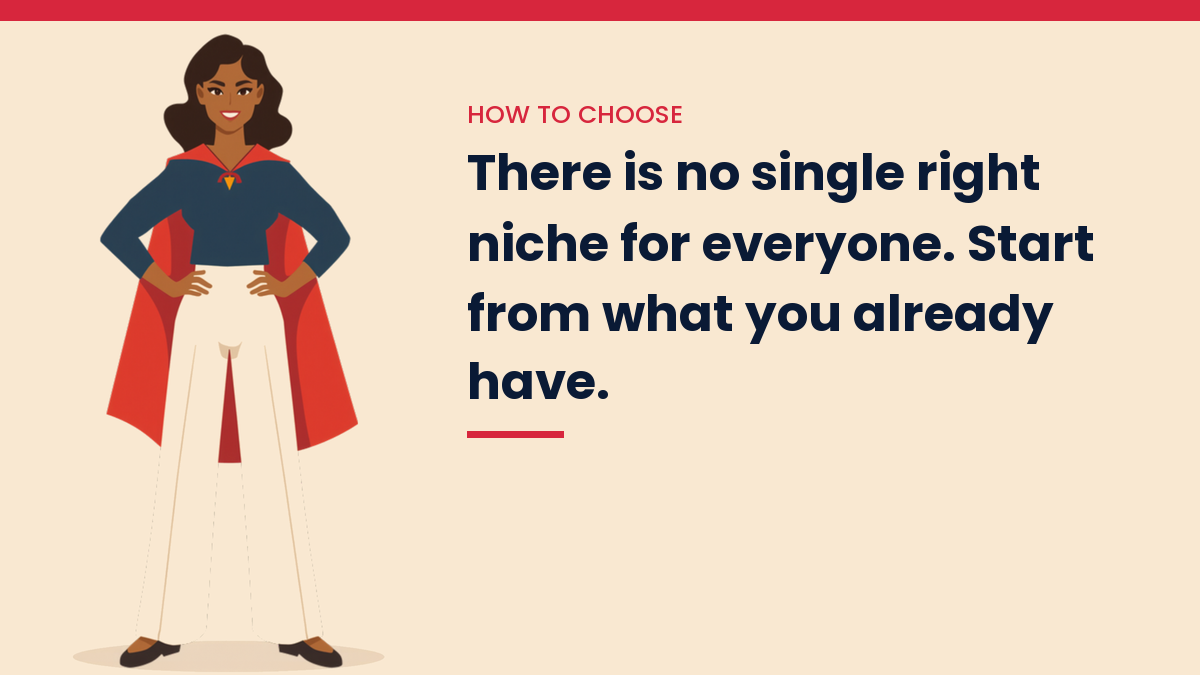
There is no single right niche for everyone. Choose using what you already have:
- You like writing: content creation, or a YouTube channel built on scripts.
- You are visual: AI-assisted design, starting with digital products you can sell.
- You like systems: automation services.
- You like digging for answers: market research.
- People ask you how to do things: workflow consulting.
If two fit, pick the one where you can show a sample soonest. If you would rather build your own site than work for clients, read how to choose a blog niche next.
What mistakes do beginners make with AI niches?
- Publishing AI output without editing or fact-checking it.
- Trying a new tool every week instead of learning two properly.
- Waiting to feel ready instead of building a portfolio piece.
- Ignoring how clients will find you. A skill nobody knows about earns nothing.
- Quitting after a few weeks. Every niche here takes months of steady work.
Questions people ask
Which AI niche is a good first choice for beginners?
AI content creation is the usual starting point because it needs almost no money and businesses already buy it. If you dislike writing, AI-assisted design is the closest alternative.
Can beginners really make money with AI?
Yes, but the money comes from what you deliver, not from the tool. Beginners who earn tend to pick one niche, build samples, and find clients or an audience the ordinary way.
Do I need programming experience?
No. All six niches run on no-code tools. Automation is the most technical, and even there you connect apps through menus rather than code.
Which AI niches can lead to recurring income?
Automation services and workflow consulting, because clients often pay monthly to keep things running. Content creation can become recurring too once you sell monthly packages.
Which AI tools should beginners learn first?
One chat assistant (ChatGPT or Claude), Canva, and one research tool such as Perplexity. Add Zapier or Make if you go into automation.
How do I find clients or readers for an AI niche?
Show your samples where your buyers already look, and if you build your own site, write about the questions they search for. A beginner-friendly way to find those questions is to use AI for keyword research and then aim for low-competition keywords a new site can actually rank for.
Final Thoughts
All six niches pay for the same thing: a real problem solved for a real person, with AI doing the heavy lifting in the background. Choose one, learn two or three tools well, make a sample this week, and show it to someone who might pay for it.
For the bigger picture of turning a skill into an online business, read how to use AI to build an online business, or browse more ideas in Online Income.
Start with the full guide: How to Use AI to Build an Online Business
Keep reading
Get the free VivaMomentum Starter Kit
Discover more from VivaMomentum
Subscribe to get the latest posts sent to your email.