
There are two stories about AI and online business, and both are wrong.
The first says you can push a button and wake up to a website that earns money. The second says AI content is worthless and using any of it will get you punished. If you have been reading about this for more than a week, you have met both. Usually from someone selling something.
The truth is duller and more useful. AI is a very good assistant for a handful of specific jobs, and it quietly hurts you on a handful of others. Knowing which is which is most of the skill. This page is that list.
I run several content websites and use AI in all of them, every day. Not to replace the work. To remove the parts of the work that were never the point.
If you are brand new and want the whole road map first, read Start Here and come back. This page is step one of that road.
The one idea that makes the rest make sense
AI is the accelerator. It is not the engine.
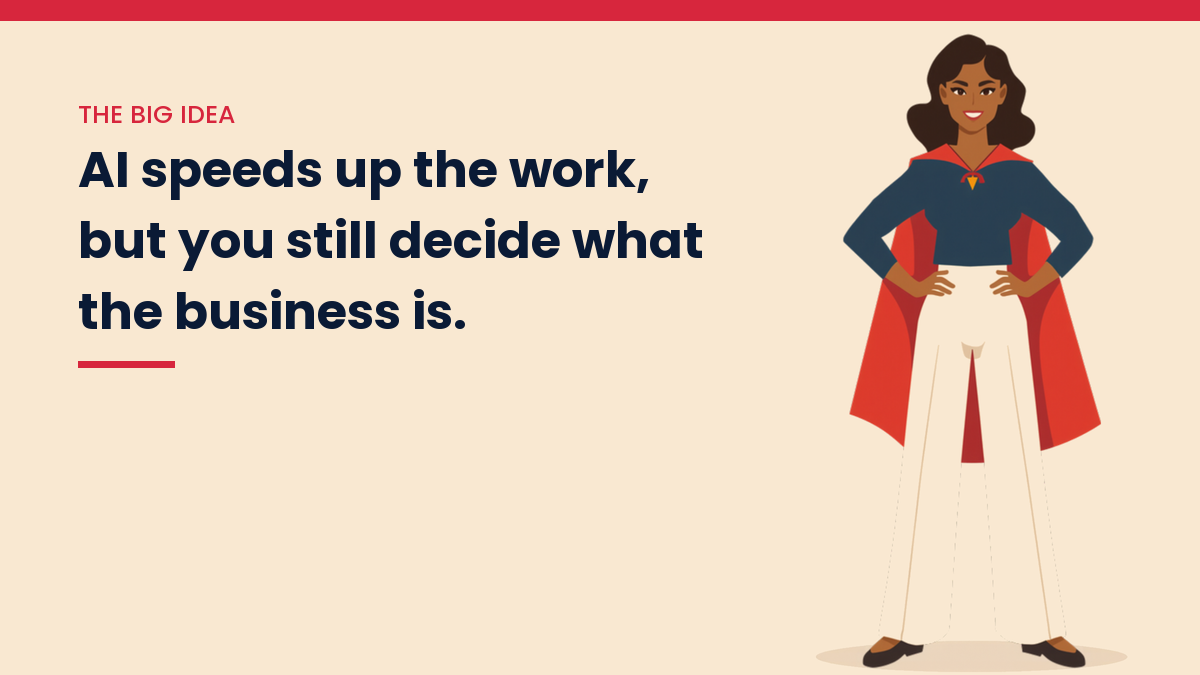
The engine is the business itself. A topic people care about. Content that truly helps them. Traffic. A way to earn from it. That has not changed in twenty years and it is not changing now. AI makes each of those steps faster. It does not do any of them for you.
This matters in a practical way, not just a philosophical one. If you build your business around a method, you can swap tools whenever a better one shows up. If you build it around a tool, you start over every time that tool changes. And in this field, tools change about every six months. I have watched it happen enough times to stop being surprised by it.
So the question is never “which AI should I use.” It is “which part of my work should AI touch.”
What AI is genuinely good at
Research and mapping a subject
This is the strongest use, and it is the one beginners skip, because it is not exciting.
Take a topic you are thinking about. Ask AI what questions a complete beginner asks about it. Ask it to sort those questions into groups. Ask which ones someone would search before buying anything and which ones they would search after. In an hour you can map a subject that would otherwise take weeks of guessing.
What you get is a list of candidates, not answers. AI cannot tell you how many people search a term. It will give you a confident number that is simply made up. Check the real demand yourself afterwards.
Structure
Give AI a topic and your rough notes and ask for an outline. It is good at this, because structure is a pattern problem, and patterns are what these systems do.
It is also good at the reverse. Paste in a draft you wrote and ask what a reader would still be confused about. It will often catch the step you assumed was obvious.
Repetitive production
The narrower the task, the better it does. “Write me an article” gives you something forgettable. “Here is my finished article. Write five Pinterest descriptions in this exact format, each under 200 characters, each using a different angle” gives you something you can use right away.
This is where the real time saving lives. Not in the writing. In everything that surrounds the writing.
Being a second opinion at 11pm
Harder to measure, still worth a lot. Working alone means there is nobody to ask whether an idea is any good. AI is a fair sounding board, as long as you remember that it agrees with you far too easily and needs pushing.
What AI is bad at, and what it costs you
Substance
AI can only recombine what already exists. So it can produce a competent article on any subject, and a distinctive one on none.
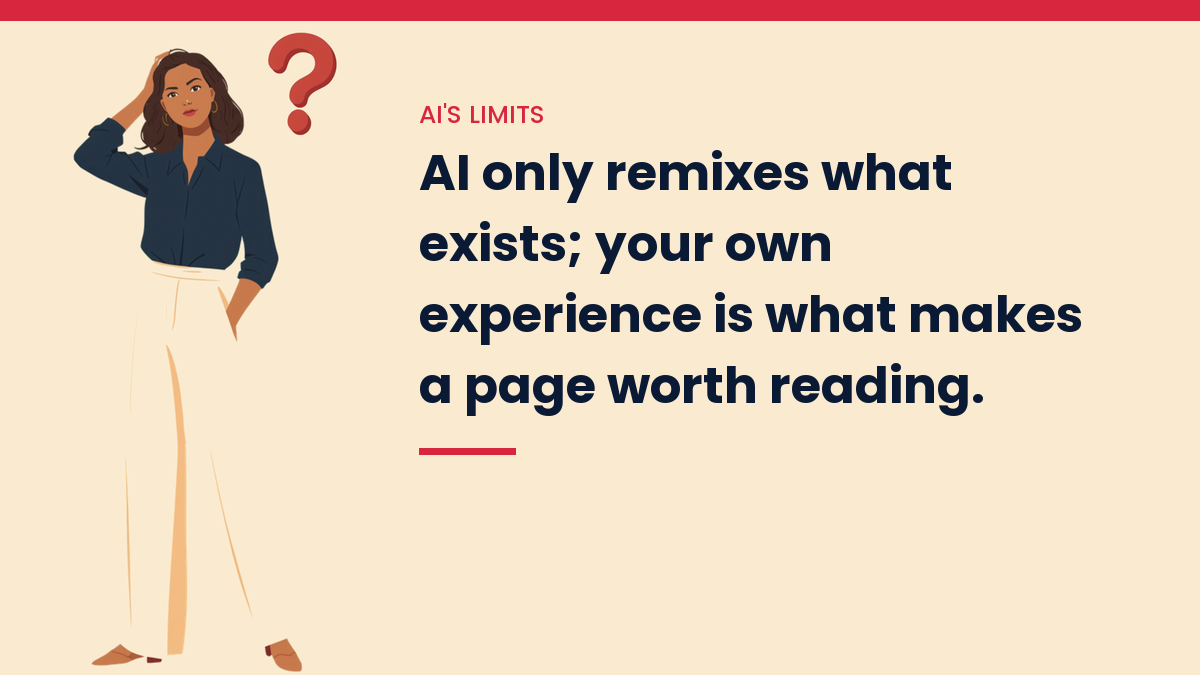
The parts of your content worth reading are the parts only you could have written. The number that surprised you. The thing you tried that failed. The step every guide tells you to do that you tried and dropped. AI has none of that. A page built entirely from AI output reads exactly like all the other pages built entirely from AI output, and there are now a great many of them.
Facts
AI states wrong things with total confidence. Prices. Statistics. Dates. Tool features. What a platform’s rules currently say. All of it can sound right and be false.
My rule is simple. Anything a reader could act on and be hurt by getting wrong, I check myself. Everything else, I still check if it is a number.
Judgment
AI will not tell you your niche is too broad. It will not tell you that you are about to spend three months on something with no audience. It will not tell you that the article you are proud of does not answer the question in its own title. It is not built to disagree with you. That part stays your job.
What changed in 2026, and why it matters more than which tool you pick
Two things shifted this year. Both point the same direction, and both make the advice above more important, not less.
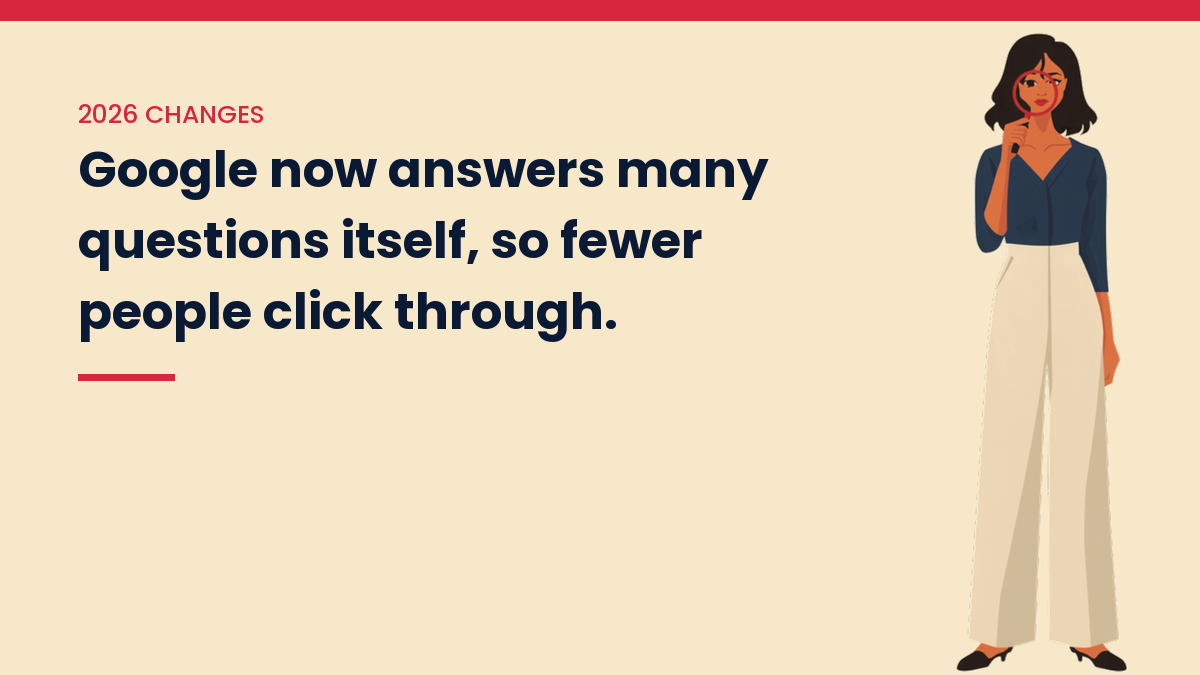
Google now answers a lot of questions itself
AI Overviews are the answer box Google writes at the top of the results. They are no longer rare. By March 2026 they were showing on roughly half of all searches, up from about a third in December 2025.
When one shows, fewer people click anything. An Ahrefs study published in February 2026 measured about a 58% drop in clicks for top-ranking pages when an AI Overview appears, roughly double what the same study found in 2025. Pew Research found about 8% of people click a normal result when an overview is present, against about 15% when it is not.
Here is what that means for you, in plain terms. Pages that only define a thing are dying. “What is affiliate marketing” is a question Google will now answer without sending anyone anywhere. Pages built on something Google cannot write for itself, like what actually happened when you tried it, still get the click. So if you were planning to build a site out of tidy definitions, that plan aged badly this year.
Google spent 2026 hunting mass-produced pages
The March 2026 core update named scaled content abuse as a main target. The August 2026 spam update, which rolled out over a few days in mid-August, went after the same thing again.
Read Google’s own wording carefully, though, because most people get this wrong. The policy does not care how a page was made. It cares whether a lot of pages were pushed out mainly to game rankings, with little value to anyone reading. Human-written, AI-written, scraped, it is treated the same way. AI-assisted content that is edited, accurate and actually helpful is not against the rules and never was.
So the risk is not “I used AI.” The risk is “I published fifty thin pages in a month because it was cheap.”
Which AI tool should you actually use?

A note on links: I’m not an affiliate for any of the tools below, so nothing on this page pays me either way.
Short answer: almost any of the big three is fine for what you are doing. The difference between them is far smaller than the difference between publishing and not publishing.
Longer answer, as of late 2026, and please check current pages before you pay for anything, because these move constantly:
- ChatGPT removed the message cap on its free tier in August 2026. Free accounts now get unlimited everyday text chats, but they are locked to one model, with the stronger ones behind the paid plan.
- Claude still limits its free tier to a rough window of messages every few hours. Enough to test it, not enough to work in all day.
- Gemini limits its free tier by compute rather than a published message count, and it reset the price of its entry-level paid tier downward in June 2026.
All three land around $20 a month for the normal paid plan, with heavier tiers above that. Start free. Pay only when you hit the ceiling doing real work, not before.
One thing that is worth more than tool-shopping: learning to write a better prompt. OpenAI publishes a short, plain guide to prompting best practices that takes ten minutes to read and applies to the others too. Ten minutes there will do more for your output than a week of comparing tools.
If you want a fuller tour of the smaller tools around the writing, I keep a list of AI tools for content creation and digital marketing.
The order to use AI in
Most people use AI at exactly one point, writing the article, which is the point where it adds the least and risks the most. Here is a better order. It maps onto the Content-to-Income System.
- Choosing a topic. AI helps you explore. You decide.
- Research. Its strongest use. Map the questions, then check real demand yourself.
- Outlining. Good here. Give it your angle so the structure serves your point.
- Writing. Use it for sections you already understand. Supply the specifics yourself.
- Editing. Ask what is missing or unclear. Much better than asking it to rewrite.
- Production. Pin descriptions, meta descriptions, social copy, summaries. Excellent.
- Systemising. Turn tasks you repeat into saved prompts with fixed formats.
Notice that writing is one step out of seven, and not the most valuable one.
The mistakes that cost people months
- Publishing at volume because it is now cheap. The most common and most expensive error, and after this year’s updates, the most dangerous one. A new site that suddenly publishes a hundred articles looks like exactly what it is. Cheap production is not a reason to make more. It is a reason to spend the saved time making each piece better.
- Letting AI pick the niche. Ask for profitable niches and you get the same handful everyone else was given. Those are the most crowded topics on the internet for exactly that reason. If you want a sane way through this, read the niche breakdown here.
- Publishing without reading it yourself. Obvious, and very common. If you would not put your name on a sentence, do not publish it.
- Chasing tools instead of doing the work. Time spent testing the twelfth AI writing tool is time not spent publishing.
- Trusting a number because it sounded confident. Every price, statistic and platform rule in this article was checked by hand before it went up. Do the same with yours.
What this looks like in an actual week
- Monday. Pick the week’s topic. Map reader questions with AI. Check the demand yourself.
- Tuesday. Outline with AI, then write the sections only you can write.
- Wednesday. Finish the draft. Ask AI what is missing. Fix it. Read it aloud once.
- Thursday. Publish, then have AI produce the pins, the meta description and the email copy.
- Friday. Schedule distribution. Update one older article.
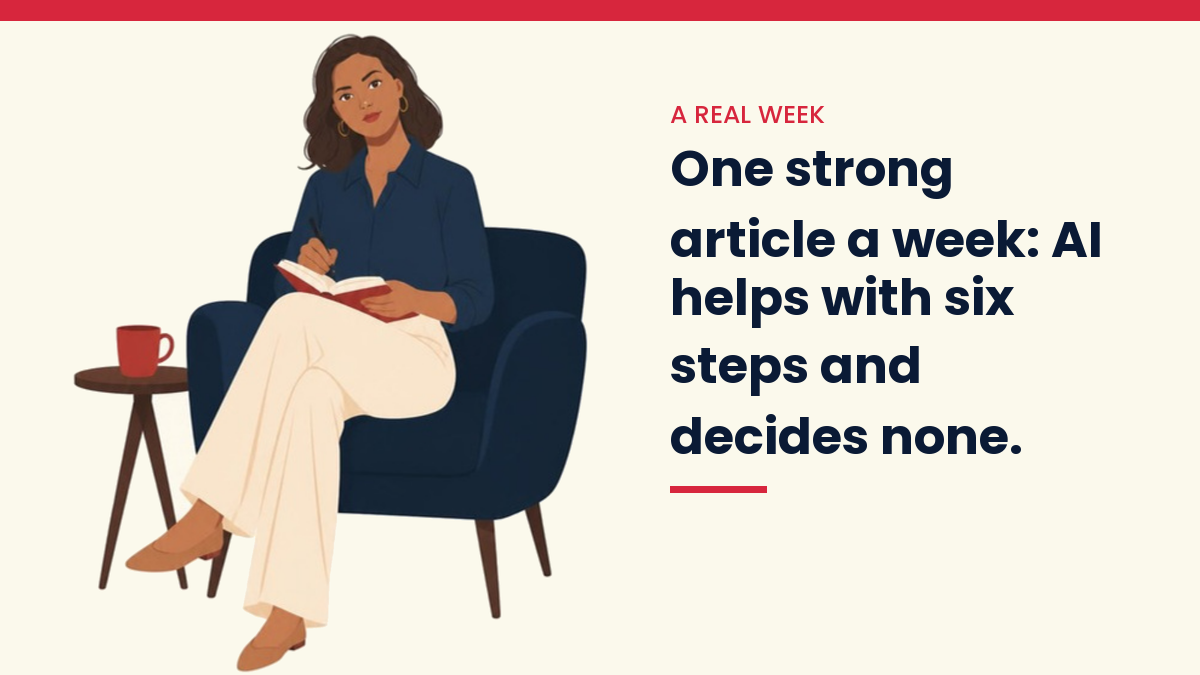
That is one strong article a week, with AI touching six of the ten steps and deciding none of them. It is not exciting and it compounds, which is the only thing that has ever worked.
Where to go next
This page is step one: what AI should and should not touch. Step two is the build itself.
Go to How to Build a Niche Website With AI: The First 90 Days. That is where the method above turns into a site with pages on it.
After that comes getting traffic to a new website, and then turning that traffic into money. Four steps, in that order. Skipping one is the reason most people stall.
If you would rather browse than follow a path, everything on this subject lives in AI for Beginners.
And if you take one thing from this page: the people doing well with AI right now are not the ones using it most. They are the ones who worked out which parts of the job to keep.
You Might Also Like
- How to Build a Niche Website With AI: The First 90 Days
- How to Get Traffic to a New Website
- How to Make Money With a Blog
- 6 AI Niches for Beginners to Earn Money in 2026
- AI Tools for Content Creation and Digital Marketing
- Beginner Mistakes in Online Business That Keep You Broke
- Why Pinterest Is a Traffic Source That Doesn’t Punish You for Being Camera-Shy
- The Content-to-Income System
More in this topic:
- How to Make Money With AI For Free: Start Here With Zero Budget
- 25 AI Prompts for Starting an Online Business
- Claude vs ChatGPT for Beginners: Which One Should You Try First?
- AI Business Ideas in 2026: 12 Profitable Opportunities Anyone Can Start
Get the next build in your inbox
How I actually grow content sites, one practical email at a time. Sign up and get my free guide, Claude in Production. Just want the Starter Kit? Download it here, no sign-up needed.
Discover more from VivaMomentum
Subscribe to get the latest posts sent to your email.