Most people who want to build an online income stream do not fail because they lack information. They fail because they have too much of it, arriving in the wrong order.
You read an article about keyword research. Then a thread about Pinterest. Then someone tells you email lists are everything, and someone else says email is dead and you should be posting reels instead. Each piece of advice is reasonable on its own. Together they are noise, and noise is exhausting. You end up busy for months with nothing to show for it.
What actually works is far less exciting than it sounds. It is a sequence — the same ten steps, in the same order, repeated until they become boring. I have run that sequence across several content websites since 2016, and the order has never changed, even though the tools have changed completely. This page is that sequence. Every other guide on this site is a close-up of one step in it.
What an online income stream actually is
Let me clear up the words first, because they get used loosely and it costs people years.
A side hustle is work you trade hours for. You stop, the money stops. An online income stream is an asset. You build something once — an article, a page, a product — and it keeps earning while you sleep, get sick, or go on holiday. It is slower to build and much harder to kill.
That difference is the whole point. A freelance gig can pay you next month. An income stream pays you in year two, and then keeps paying. Most people quit somewhere in between, because nobody told them the middle part is quiet and boring.
The honest timeline, with real numbers
People selling courses will tell you six weeks. People who are tired will tell you never. The truth sits in between, and there is survey data on it.
- Across blogging income surveys, the average time to first money is around 21 months. That number is long because it includes everyone who published twice and stopped.
- About a quarter of bloggers earn something within six months. Those are almost always the ones who picked a narrow topic and kept publishing.
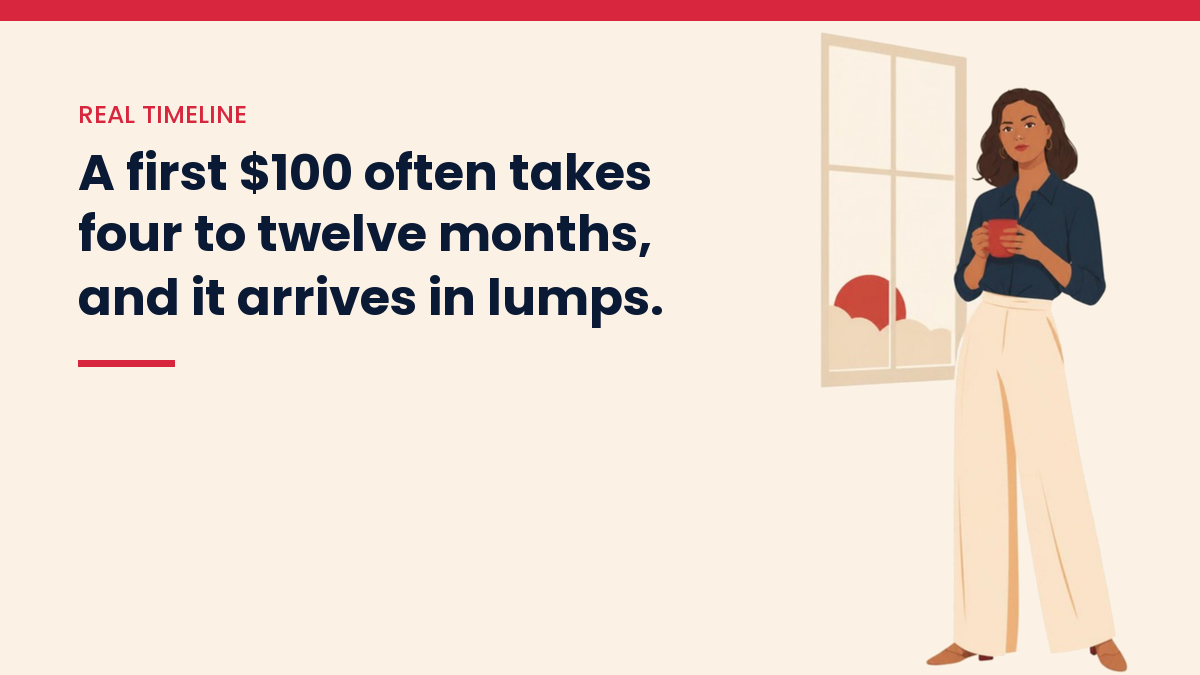
- A realistic target for a first $100 is four to twelve months, and it will not arrive as a steady climb. It arrives in lumps.
Read that second point again, because it is the useful one. The people who get there faster are not smarter. They are narrower. Search traffic takes months to mean anything, and Pinterest can bring visitors sooner — which is exactly why step five below sits where it does.
The system in one screen
- Find an opportunity
- Research it with AI
- Create genuinely useful content
- Optimise it for search
- Distribute it on Pinterest
- Build an email audience
- Monetise the traffic
- Systemise the repetitive work
- Measure what is working
- Improve and repeat
Ten steps, one loop. Now the detail.
Step 1: Find an opportunity
An opportunity is a group of people asking questions that nobody has answered well. Not a topic you like. A gap.
The test I use is simple and slightly unromantic. Could you write fifty articles about this without resenting it? Do real people search for it? Does money change hands in this world — a product, a course, a tool, an ad?
If you cannot answer all three with a yes, you have a hobby, not an income stream. That is fine. Just know which one you are starting. If you want help narrowing it down, how to build a niche website with AI walks through the choosing part slowly.
Step 2: Research it with AI
This is where AI earns its place. Ask it to list the questions a total beginner asks about your subject. Ask what the top pages fail to explain. Ask what words real people use, which are almost never the words the industry uses.
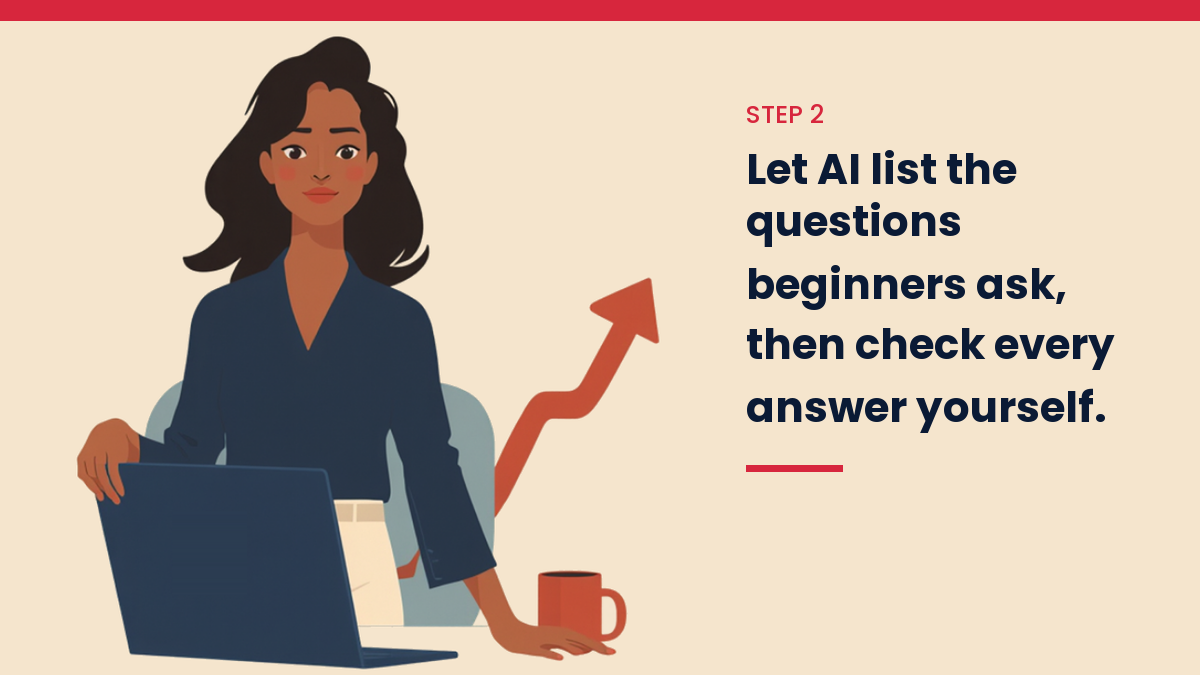
Then go and check. AI will hand you a confident list, and some of it will be wrong or three years out of date. Search the terms yourself. Read a forum thread. The checking is the research. The list is just a faster start.
Step 3: Create genuinely useful content
Useful means the reader leaves able to do something they could not do before. That is a higher bar than “well written.” A smooth article that repeats what five other pages already said is worth nothing, to readers or to search engines.
AI is good at structuring an article and at catching what you forgot to cover. It is bad at the thing that makes content worth reading: the specific detail that only comes from having done it. The measurement that surprised you. The step that went wrong. The number from your own dashboard.
So the rule is simple. Use AI for the scaffolding. Supply the substance yourself.
Step 4: Optimise it for search
Optimisation is mostly clarity. Put the phrase people search for in the title. Use headings that describe what is under them. Answer the main question near the top instead of making people scroll past your life story. Link to your own related articles so the topic holds together. That is the bulk of it, and the complicated technical work matters far less than people pretend.
What changed in 2026, and why it matters
Google now shows AI-written answers at the top of many searches. When one of those appears, far fewer people click through to a website. An Ahrefs study published in February 2026 found click-through rates on top-ranking pages dropped by around 58 per cent on those searches — roughly double the drop measured in 2025. Pew Research found only about 8 per cent of people click a normal result when an AI answer is sitting above it, against 15 per cent when there isn’t one.
That is not a reason to quit. It is a reason to change what you write. The pages still getting clicked are the ones an AI summary cannot replace: your own testing, your own photos, your own numbers, opinions, comparisons, step-by-steps with pictures. The pages losing most are the plain definition pages — “what is X” — exactly the kind of article AI writes for free. It also means search alone is a shaky foundation now, which brings us to the next step.
Step 5: Distribute it on Pinterest
New websites have a waiting problem. Google takes months to trust you, and months with no traffic is where most people quit. Pinterest shortens the wait. It is not a social network, it is a visual search engine, and it does not care how old your domain is or how many followers you have.
Now the honest part. Pinterest got harder in 2026. A ranking change rolled out from late 2025 into early 2026, and plenty of bloggers watched impressions fall hard — 500,000 a month down to 150,000 was a common story. Others saw impressions hold steady while clicks quietly dried up, because Pinterest now matches pins to what someone actually wants, not just to matching words.
What seems to help, from the people who recovered: tidy up and merge overlapping boards so each one means something, write pin descriptions that match the real search a person would type, and keep pinning through the dip instead of panicking. The accounts that stopped did not come back. Pinterest SEO for beginners covers the practical side, and how to get traffic to a new website covers what to do while you wait for Google.
Step 6: Build an email audience
Everything in steps four and five is rented. Google changes an algorithm, Pinterest changes a feed, and traffic you depended on halves in a week. It happens to everyone eventually, and it has happened to me.
An email list is the only audience you own. It is also the least exciting thing on this list, which is why most beginners skip it and then wish they hadn’t. Start it on day one, even if it collects four addresses a month. Four hundred people who chose to hear from you is worth more than forty thousand strangers passing through.
You do not need to pay for this at the start. Most email tools have a free tier that carries you past your first thousand subscribers. Check the current limits yourself, because those free tiers change often and every published list of them goes stale.
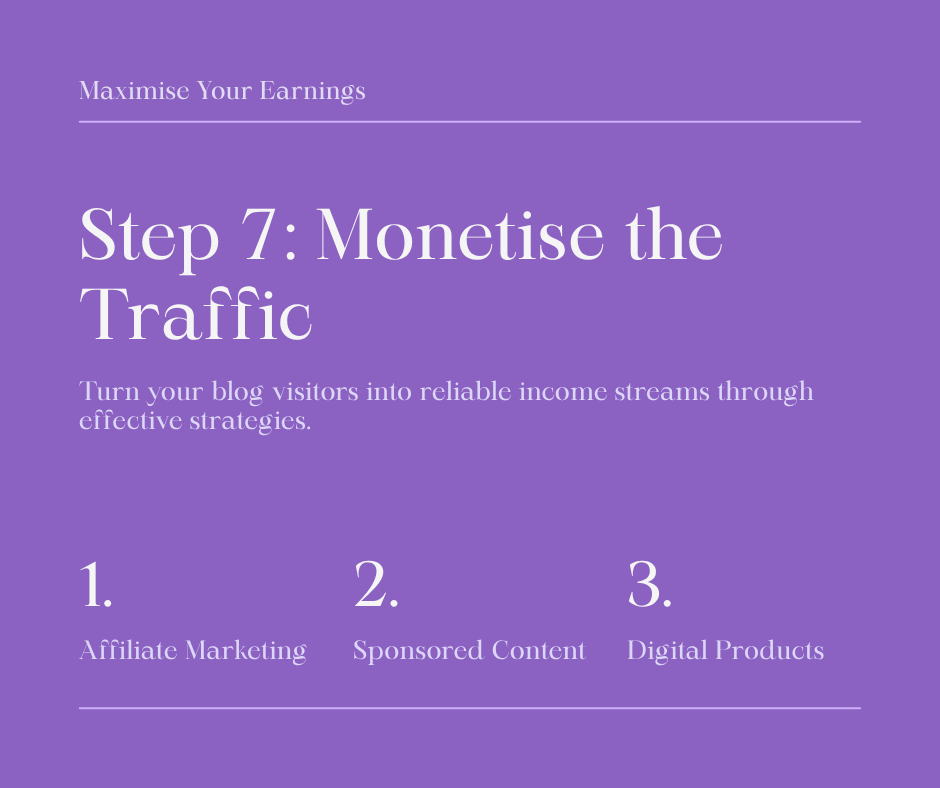
Step 7: Monetise the traffic
A note on links: I’m not an affiliate for any of the companies named below, so nothing on this page pays me either way.
Only now, and deliberately so. Monetising too early is the most common self-inflicted wound in this business. Ads stuffed onto a site with no traffic earn nothing while making the site unpleasant enough that it never gets any. There are three realistic routes, and they suit different sites.
- Display ads pay you for attention. Easy to set up, low control, and you need real traffic before the numbers mean anything.
- Affiliate income pays you when a reader buys something you recommended. Works well when you genuinely use the thing and say out loud where it is weak.
- Your own product pays the most per reader and takes the most work. This is where a small, loyal audience beats a big one.
How much traffic you actually need for ads
This is the question everyone asks and few guides answer with current numbers, so here is where the main ad networks stood as of early 2026. Check them yourself before you apply — these thresholds move.
- Journey by Mediavine — the beginner tier. From January 2026 you can apply with about 1,000 sessions a month from countries like the US, UK, Canada and Australia. That is genuinely reachable in your first year.
- Mediavine — no longer a flat traffic number. They now look at whether the site is already earning meaningfully, in the region of $5,000 a year.
- Raptive — dropped its minimum from 100,000 to around 25,000 monthly pageviews in late 2025, which put it within reach of far more small sites.
Notice how low the first rung now is. A thousand sessions a month is a real, ordinary goal. That is roughly thirty visitors a day. How to make money with a blog goes route by route through all three options and what each one pays.
Step 8: Systemise the repetitive work
This is the step that separates a website from a job you gave yourself. The rule I use: the first time you do something, just do it. The second time, write down how. The third time, turn it into a checklist or hand it to a tool. Publishing an article, making pins, sending the weekly email — all of it becomes a repeatable process instead of a decision you make from scratch every week.
Decisions are what tire you out. Not the work.
Step 9: Measure what is working
Most people either never look at their numbers or look at them every single day. Both are avoidance. Once a month is right, and four questions are enough. Which pages brought the most visitors? Which brought the most income? Which recent articles did nothing at all? What did I publish that I would not publish again?
The middle two change what you do next. Traffic that earns nothing is a hobby with extra steps.
Step 10: Improve and repeat
Improving old articles almost always beats writing new ones. An article already sitting on page two, brought up to date and properly linked, will usually outperform a brand-new article on the same subject — because it already has history you cannot manufacture.
Then the loop starts again with a new opportunity, and it is a little easier each time.
Where AI actually fits
“Use AI” has become advice so vague it means nothing, so let me be precise. AI is the accelerator, not the engine. It makes research faster, drafting faster, and repetitive production much faster. It does not decide what is worth writing, it does not supply your experience, and it cannot tell you whether a page is any good.
There is a harder edge to this in 2026. The more your site reads like something an AI could have produced, the more directly it competes with the free AI answer at the top of the search page. Sounding like a person is no longer a style choice. It is the thing keeping you in business. How to use AI to build an online business goes further into where the line sits.
Why most people never get there
I want to name these plainly, because every one of them is fixable.
- They picked a topic that was too broad. “Personal finance” is not a topic. “Budgeting on an irregular freelance income” is.
- They rebuilt the website instead of writing. Nobody has ever failed because of their theme.
- They quit in month four. Month four is exactly when nothing is happening yet. That is not a signal. That is the shape of it.
- They published fast, thin AI drafts. This worked for a while. It does not now, and the sites that did it hardest fell the furthest.
- They never started the email list. Then traffic dipped and there was nothing left.
If you want the longer version of this, why most people fail to make money online is uncomfortable reading in a useful way.
The people who make it are not the talented ones. They are the ones still publishing in month nine.
Where to start this week
Do not try to run all ten steps at once. Do the first three. Choose one narrow topic you could write about fifty times without resenting it. Spend an hour mapping the questions beginners ask about it. Write one genuinely useful article answering the most common of them.
That is a real week’s work, and it is further than most people ever get. Next week you do it again. That is the whole secret, and I am sorry it is not more interesting. If you are starting from nothing, start here puts the first four weeks in order for you.
Common questions
Can I build an online income stream with no money?
Almost. A domain runs about $10 to $15 a year and basic hosting $3 to $10 a month, so a realistic first year sits well under $200. Everything else — Pinterest, an email tool, AI tools — has a free tier good enough to start on. What it really costs is time, and that part cannot be bought down. I would not spend money on a course until you have published twenty articles.
How many articles before anything happens?
There is no magic number, but twenty to thirty solid articles on one narrow subject is roughly where sites start to show signs of life. Fewer than ten and you have not given it a fair test.
Is blogging dead now that AI answers everything?
Generic blogging is in real trouble, and pretending otherwise would be dishonest. Sites built on definitions and summaries lost a lot of traffic. What still works is first-hand material — things you tested, photographed, measured or got wrong. An AI answer cannot produce that.
You might also like
- Start Here — the four-week plan from zero.
- How to Use AI to Build an Online Business
- How to Build a Niche Website With AI
- How to Get Traffic to a New Website
- Pinterest SEO for Beginners
- How to Make Money With a Blog — the three income routes compared.
- 6 AI Niches for Beginners to Earn Money in 2026
More in this topic:
- 20 Digital Products That Sell Online (Beginner-Friendly + Good for Etsy)
- AI Business Ideas in 2026: 12 Profitable Opportunities Anyone Can Start
- 14 Passive Income Ideas for Beginners That Actually Work in 2026
- 14 Ways to Make Money Online Without Showing Your Face
- 26 Quick Online Business Ideas That Will Be Huge in 2026
- How to Start an Online Business From Home (After Failing Before)
Get the next build in your inbox
How I actually grow content sites, one practical email at a time. Sign up and get my free guide, Claude in Production. Just want the Starter Kit? Download it here, no sign-up needed.
Discover more from VivaMomentum
Subscribe to get the latest posts sent to your email.